

Turn sales, par levels, and location demand into tighter restock plans so drivers carry less guesswork and fewer empty machines during each service week.
Restock With Data
Plan routes, pre-kits, and service stops around real location needs so drivers spend less time overloading trucks or chasing preventable outages.
Cut Route Waste
Track counts, camera notes, and location issues in one place so open-market losses are easier to spot, discuss, and reduce before they feel normal.
Protect Market Shrink
Capture card issues, refund requests, and failed vends in a clean support flow so customers get answers and accounts see problems handled promptly.
Recover Failed Vends


Systems Customized to Meet Your Needs
Our systems are developed around the way vending routes, micro markets, warehouse stock, payment issues, and account relationships actually operate:
Marketing & Visibility - Clarify breakroom offers, account targets, referral paths, cashless messaging, and renewal reasons.
Lead Capture & Intake - Capture location type, traffic, machine count, market format, site contact, access, power, and payment needs.
Quote & Approval Flow - Manage proposals, placement terms, commissions, equipment approvals, install dates, refunds, and invoices.
Scheduling & Dispatch - Plan restock routes, pre-kits, driver work, service calls, installs, repairs, and account visits by location need.
Field Execution - Give drivers location notes, par levels, pick lists, photos, issue logs, shrink checks, and closeout steps.
Customer Communication - Send site updates, refund replies, account reports, service notes, issue recovery, and renewal reminders.
Service History & Retention - Track locations, machines, markets, shopper issues, decision-makers, manager changes, and account history.
Reviews & Reporting - Track sales, shrink, product mix, refunds, route time, stock risk, account health, and margin.
Top Ten Points of Failure for Vending / Micro-Market Systems
1. Static routes and guess-based restocking
Owners say route plans often get built from habit instead of current location demand. Static schedules and broad restock assumptions send drivers out with the wrong load, too many stops, or not enough product where sales are moving fastest.
2. Warehouse picking and truck-load waste
Managers indicate that weak picking systems turn warehouse disorder into route disorder. Overstocked trucks, slow pre-kitting, and missed pull lists cost driver time, create extra returns, and make the route feel heavier than it should.
3. Inventory gaps across warehouse, truck, machine, and market
Operators report that inventory can look acceptable in one place while the machine, market shelf, truck, or garage tells a different story. Without one operating picture, the business sees waste and missed sales at the same time.
4. Overstock, expiration, spoilage, and dead stock
Owners describe loading products just in case because location-level visibility is not reliable enough. That habit protects against empties in the short term, but it creates expired products, stale inventory, and margin loss over time.
5. Out-of-stocks that weaken account confidence
Account contacts notice empty spirals, empty coolers, weak variety, and slow replenishment. Managers indicate that visible outages are not just sales misses; they are relationship warnings that can put a location at risk.
6. Micro-market theft and shrink exposure
Operators say micro markets can unlock higher sales and better variety, but shrink changes the risk calculation. Counts, camera notes, signage, product placement, and location discussions need a repeatable process before loss becomes normal.
7. Failed vends, card charges, and refund drag
Customers blame the operator when a card is charged and the item does not vend. Refund requests, price mismatches, reader issues, and rude recovery experiences can become account problems when support is informal.
8. Cashless reader and connectivity blind spots
Cashless is baseline behavior in many locations, but readers, kiosks, and connectivity can quietly create lost sales. Owners need a way to see payment issues, route them, and explain them before shoppers or account contacts escalate.
9. Software that is too heavy for lean operators
Small and midsize operators say they want route, stock, purchasing, tax, and reporting control without enterprise friction. Tools that are powerful but unintuitive lead to workarounds, partial adoption, and owner frustration.
10. Account fragility when site managers change
Service frequency alone does not protect a location when a new manager arrives. Owners need account history, stakeholder notes, issue records, service proof, and reporting that preserve the relationship beyond one contact person.
Here's How We Address These Issues

Demand-Based Restock
-
Uses sales patterns, par levels, shelf counts, and location demand before routes are built
-
Builds driver pick lists around machines, markets, and expected replenishment need
-
Flags out-of-stock risk, slow movers, and fresh-item exposure before the stop
-
Separates routine restock, service calls, installs, and account visits clearly
-
Reduces guesswork, overfilled trucks, and preventable empty locations

Inventory Control
-
Connects warehouse, truck, machine, and market stock into cleaner operating views
-
Tracks on-hand counts, par levels, freshness dates, and reorder signals
-
Supports pre-kitting, purchasing discipline, and location-specific product planning
-
Makes overstock, dead stock, and missed-sales patterns easier to see
-
Gives owners a practical view without forcing enterprise software habits

Shrink Protection
-
Tracks market counts, loss patterns, camera notes, and location concerns together
-
Supports regular count routines and exception review by account or market
-
Creates better records for shrink conversations with location contacts
-
Keeps theft, spoilage, and count variance from blending into one vague number
-
Helps operators place market formats more confidently in the right locations

Payment Recovery
-
Captures failed vends, card issues, refund requests, and price concerns in one flow
-
Routes shopper complaints to the right office or account action faster
-
Keeps refund notes tied to machine, market, reader, account, and service history
-
Makes recurring payment problems easier to spot before they damage trust
-
Improves recovery without turning the owner into the support desk

Account Continuity
-
Stores decision-makers, location contacts, service history, issues, and reporting notes
-
Tracks manager changes, account risks, renewal timing, and unresolved complaints
-
Gives account teams proof of service, variety updates, and issue recovery
-
Helps protect high-value locations when personnel or expectations change
-
Turns operating data into clearer account conversations

Growth Backbone
-
Connects website forms, referrals, account targets, and renewal follow-up
-
Tracks which locations are profitable, stable, risky, or ready for expansion
-
Supports micro-market, vending, pantry, and coffee opportunities by account type
-
Gives owners clearer reporting on route cost, product mix, shrink, and retention
-
Creates a system that can support more locations without equal added chaos

Restock Route View
Route and stop visibility for drivers, pre-kits, location demand, service calls, installs, and stock exceptions. Owners can see what is loaded, what is at risk, and which accounts need attention before the route is finished.

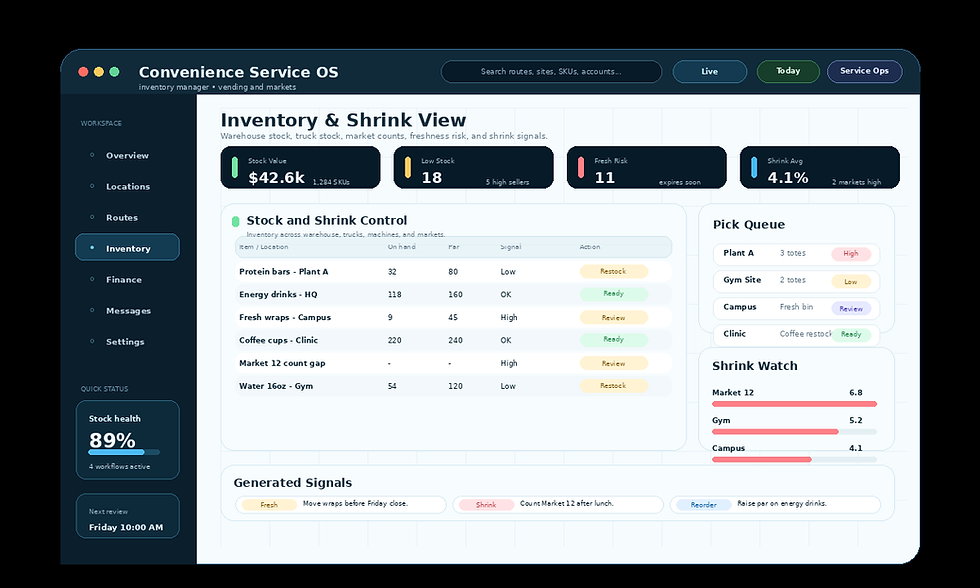
Inventory & Shrink View
A control view for warehouse stock, truck stock, machine counts, market counts, freshness risk, product mix, and shrink signals. It helps reduce overbuying, missed sales, and unexplained location losses.
Revenue & Account Intelligence
Sales, refunds, reader issues, shrink, route cost, location margin, product movement, and account-health visibility for vending owners. The view shows where revenue is strong, where waste is rising, and where accounts need follow-up.


